
Muay Thai.
Philadelphia.
Everything you need to know.
If you've been curious about Muay Thai but don't know where to start — this is the page that answers every question. What it is, what it does to your body, what a class feels like, what gear you need, and how to walk in for the first time without feeling lost.
The most efficient striking system humans have ever built — and the workout you'll actually keep showing up for.
You've probably seen it without knowing what you were looking at. A fighter on TV throwing a kick that lands like a baseball bat. A class through a gym window with people in shorts and gloves, working pads while a coach calls combinations. Eight people, eight rhythms, all of it sharp. That's Muay Thai.
It comes from Thailand. It is roughly 700 years old as an organized sport and far older as a battlefield art. It is the national sport of a country of 70 million people who treat it the way Brazilians treat soccer — total seriousness, from childhood. Children grow up watching it the way American kids grow up watching basketball.
Today, every major combat sport on earth — MMA, modern kickboxing, K-1 — uses Muay Thai as its striking foundation. No other system on earth gives you eight contact weapons inside one cohesive style. Boxing has two. Kickboxing has four. Muay Thai has all of them, plus the clinch — and it teaches them in a way that scales from "first day, never trained" to "professional fighter."
Here is what almost nobody tells you up front: for the average adult, it is, by a wide margin, the best workout they will ever do. Not because of what it teaches you about fighting — but because of what it does to your body, your wind, your posture, and your head in the first thirty days.
Two fists. Two elbows. Two knees. Two shins.
Muay Thai is nicknamed "The Art of Eight Limbs" for a reason. Tap each weapon below to see what it does, why it matters, and one thing about it that will surprise you at the dinner table.
Tap a weapon
Fists
The entry point.
Jab, cross, hook, uppercut. Most students throw their first real punch in week one — and feel a switch flip that nothing in a regular gym ever flipped.
A relaxed jab travels faster than a clenched one. Tension is the enemy of speed.
The entry point.
The closer.
The signature.
The hammer.
Forget fighting for a second. This is the workout your body has been waiting for.
Most adults who walk into a Muay Thai class for the first time aren't there to fight anyone. They're there because the treadmill is boring, the lifting routine plateaued, and they want something they actually look forward to. Here's exactly what fifty minutes does to you.
Real caloric burn
A 50-minute beginner class will out-burn an hour on the treadmill and you'll actually look forward to it.
Cardiovascular reboot
Round-based intervals rebuild your gas tank faster than steady-state cardio ever has.
Functional strength
Hips, core, shoulders, back — every kick, knee, and combination is a compound movement under load.
Mental reset
You cannot think about your inbox while learning to slip a punch. Fifty minutes is the cheapest therapy in the city.
Earned confidence
Confidence built in a fitness class fades by Tuesday. Confidence built from striking technique walks with you everywhere.
Visible change
Posture sharpens. Shoulders square up. Conditioning climbs. Most students see a difference in the mirror inside a month.
The reason it works where other workouts didn't isn't complicated. Your body isn't asking you to repeat a movement. It's asking you to solve a problem — keep your hands up, breathe through your nose, rotate from the hip, find the right distance, finish the combination. You don't have the bandwidth to be bored.
By minute twenty your shirt is soaked. By minute thirty you've forgotten the meeting you were dreading. By minute fifty you walk out with the specific kind of calm that only comes from earned tiredness. Your sleep that night is different. Your morning is different. And by the end of week two, you start catching yourself in the mirror.
"How is this different from the boxing class I tried?"
Fair question. All three are striking arts. All three will get you in shape. But what you actually learn, how complete the workout is, and how useful the skill is on the street — those are very different conversations. Here's a side-by-side.
Muay Thai
- Tools you learn
- Punches, Kicks, Elbows, Knees, Clinch
- Cardio demand
- Elite
- Full-body workout
- Yes
- Self-defense value
- Elite
- Fun factor
- Highest
Boxing
- Tools you learn
- Punches
- Cardio demand
- High
- Full-body workout
- Upper body biased
- Self-defense value
- Medium
- Fun factor
- High — but repetitive
Kickboxing
- Tools you learn
- Punches, Kicks
- Cardio demand
- High
- Full-body workout
- Yes
- Self-defense value
- Medium
- Fun factor
- High
Boxing is beautiful and pure — but you spend the entire class working only your hands. Your legs are there for movement, not for striking. Two weapons.
Kickboxing adds kicks, which is a big jump. But it's a sport invented for sport — it doesn't include elbows, knees, or the clinch. Four weapons.
Muay Thai uses every natural weapon the human body has. You learn punches, you learn kicks, you learn knees, you learn elbows, and you learn the clinch — the close-range chess match that decides most real fights. That's why it's the most complete striking workout on earth, and why it's the foundation under almost every other combat sport.
Fifty minutes. Every one of them coached.
The hardest part of starting anything new is walking in not knowing what's about to happen. So here is exactly what your first class looks like, minute by minute, before you ever set foot inside. No surprises.
Warm-up
Movement, footwork, shadow boxing. Your body wakes up, your nervous system clicks on, and by minute eight you've stopped thinking about your day.
Technique block
A coach demos one or two techniques. You drill them with a partner at a controlled pace. The coach walks the room and corrects you by name. Nobody gets left behind.
Pads & bag work
Now you apply what you just learned — with full speed and full power — on focus pads with a partner and on the heavy bag. This is the block that locks it in your body and the block that lights you up.
Conditioning + close
Short core and conditioning finisher, a brief debrief from the coach, then you walk out drenched, sharp, and quietly proud of yourself.
Beginner classes never spar. Sparring is opt-in only, fully supervised, and reserved for students who have earned the skill to do it safely.
You will not be alone, you will not be unsure of what to do next, and you will not be left in a corner. A coach walks the room from minute one to minute fifty.
Everything you need. Almost none of it you have to bring.
One of the biggest reasons people don't start a martial art is the imagined cost of "all that gear." Forget it. Gloves and hand wraps are personal — you own those, and they stay yours. Every other piece of equipment in a Muay Thai class belongs to the gym. Here's the full list, in plain English.
Bottom line: walk in with athletic clothes and a water bottle. That's it. If, after a few weeks, you fall in love with the sport and want your own gloves and wraps — we'll help you pick gear that fits your hand and your goals. Until then, you train on ours.
Taught by people who have actually done it.
A coach's credentials matter, but how they treat a brand-new beginner matters more. Here are the two people who will most likely be running your first class.
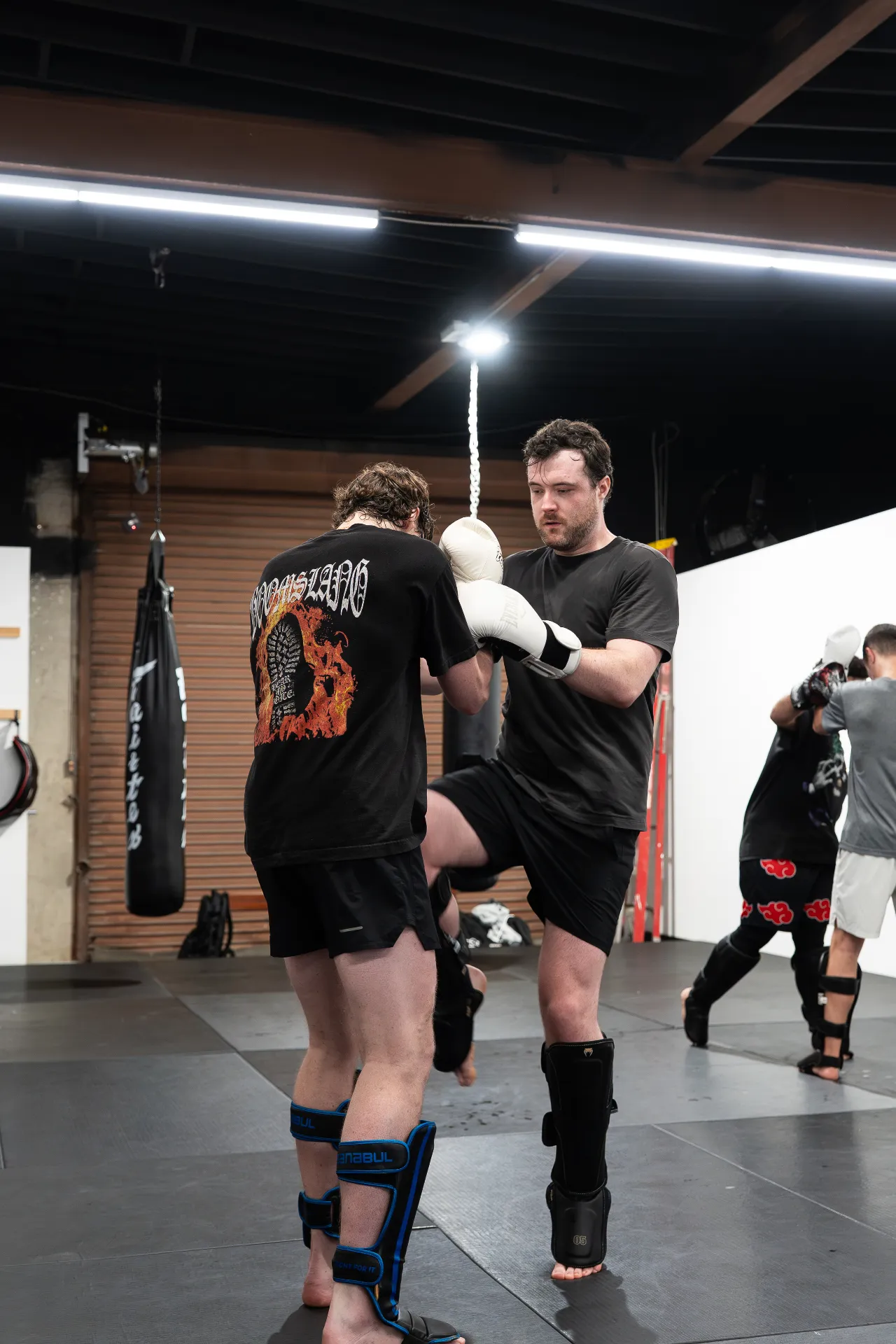
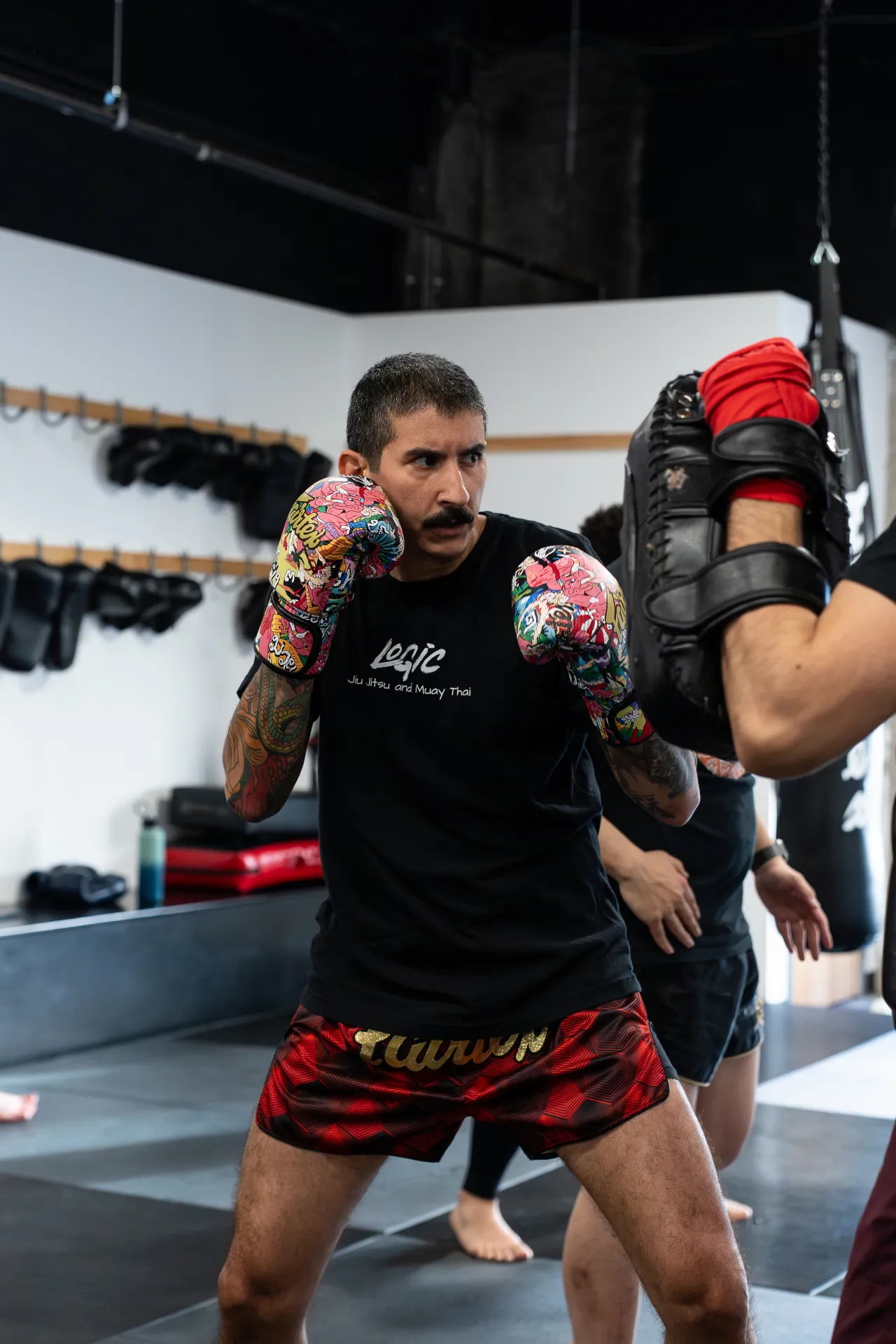
Edwin has spent his life teaching striking to beginners. Day-one students walk into his room nervous and walk out knowing more than when they came in. Every time.
Supporting instructors on the floor: Adolphus Li (5 yrs — Foundations), Fedir Lantukh (10 yrs — Boxing & Creativity), Salih Hass (5 yrs — Distance Management). Meet the full Muay Thai staff. Coming from Fishtown? See directions and class times from Fishtown.
A real curriculum. Not "show up and figure it out."
You should know exactly what you'll learn, in what order, and what you'll be able to do at the end. Here is the honest week-by-week of what happens to a complete beginner over their first six weeks of training.
Stance, jab, cross
You learn how to stand, how to breathe, and how to throw a clean punch. The first one that lands right on the pad — you'll remember it.
Hooks, footwork, defense
Combinations start. You discover slipping a punch. Your shoulders ache in the good way. Sleep gets noticeably better.
The teep & the round kick
Your first real Muay Thai kick. It feels alien on Monday. By Friday it feels like it belongs to you.
Combinations
Punch-punch-kick. Kick-knee-elbow. Patterns become reflex. Your pads sound different. So does your breathing.
Clinch & knees
Muay Thai's signature. You learn the grip, the breaks, the posture, and what a knee in the clinch actually does.
Live drills
Controlled flow with a partner. You watch yourself do things you couldn't do six weeks ago — and the person you walked in as is gone.
At the end of six weeks you will have technique, conditioning, vocabulary, and the confidence to walk into any class on the schedule and hold your own. You'll also be someone who throws a clean Muay Thai kick — which, frankly, is a thing very few people in Philadelphia can say about themselves.
1360 N American Street.
In Fishtown, on the Northern Liberties and Olde Kensington border — the geographic center of where most of Philly's young athletes and professionals already live.
- —Free private parking on-site.
- —One block from the Market-Frankford line.
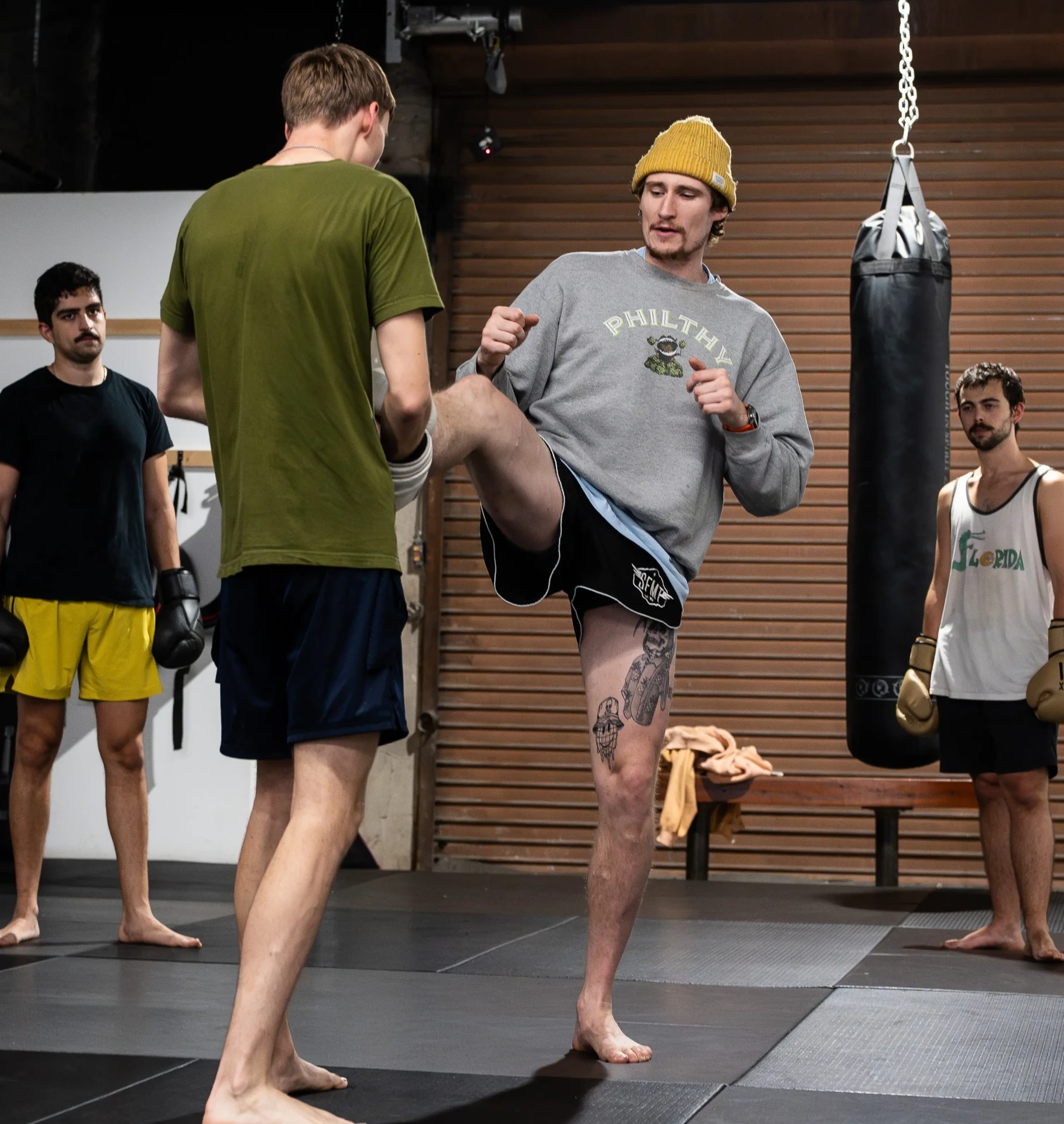
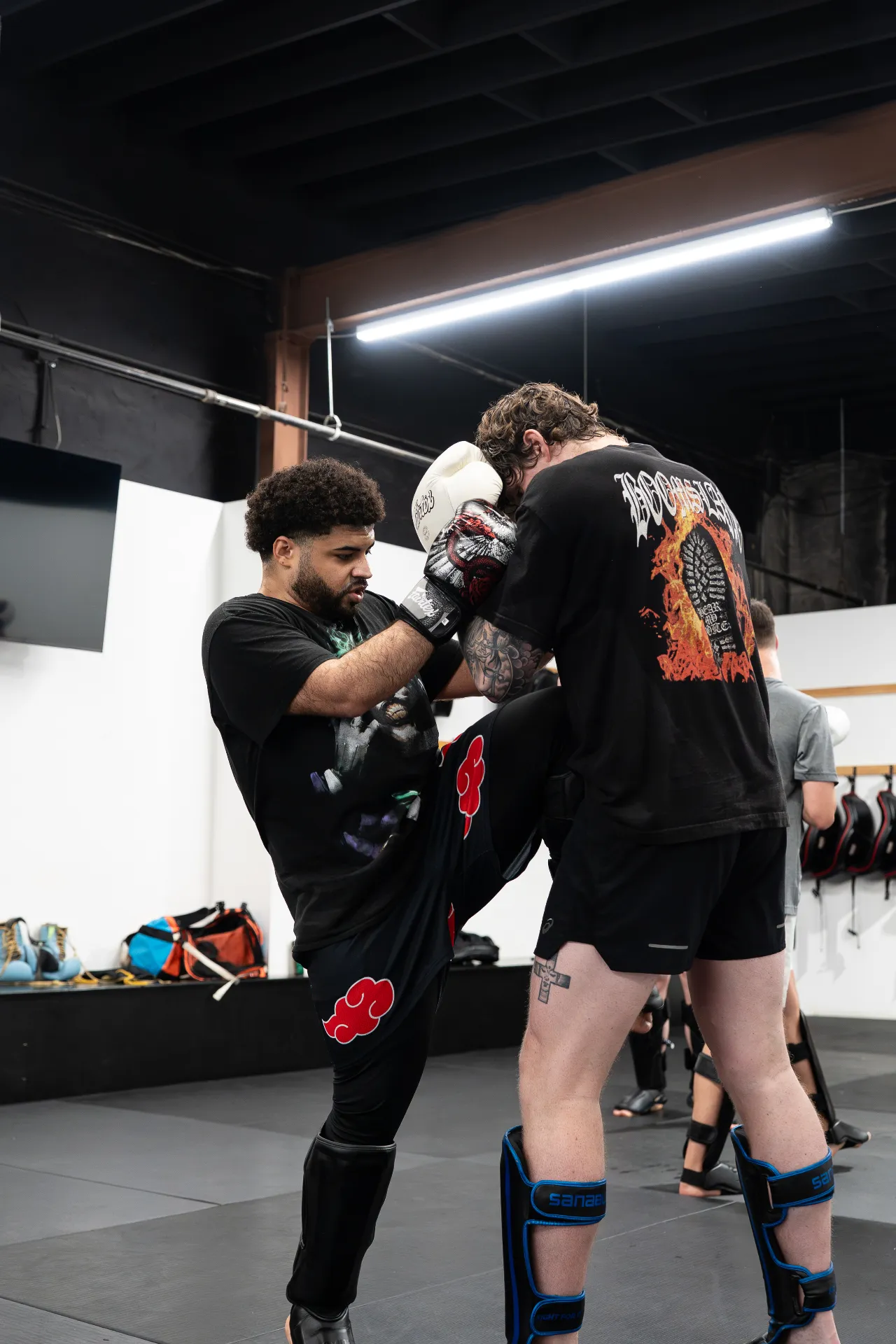
- —Real mats, real bags, real coaches.
- —No mirrors-and-music gym. No commercial-chain energy.
The questions you didn't want to ask out loud.
If something here isn't covered, you can ask it in person at a tour — no pressure, no pitch.
Seven questions to ask any gym before you pay.
Philadelphia has good Muay Thai and it has gyms that will burn a beginner out in three weeks. The difference is almost never the building — it's how the room is run. Ask these seven questions on any tour, at any gym in the city. If the answers are vague, walk.
- 01
Do beginners spar?
The right answer is no — not in the first weeks, and never without consent. A gym that puts new people into live sparring to "see what they've got" is protecting its culture, not your brain.
- 02
Who is actually teaching the beginner class?
Ask for the instructor's name, their years of experience, and whether they teach that class every week. Beginner classes handed off to whoever showed up produce inconsistent teaching and injuries.
- 03
Is there a beginner-specific class, or one class for everyone?
Mixed-level rooms move at the pace of the experienced students. A separate beginner track means the technique is taught from step one instead of assumed.
- 04
What is the coach-to-student ratio?
One coach correcting thirty people is a workout class. Ask how many people are on the floor at peak times and how many coaches walk the room.
- 05
What equipment do I have to buy on day one?
Gloves and hand wraps are personal and hygienic — expect to own those eventually. Bags, Thai pads, and shin guards should be provided by the gym. If you're asked to buy hundreds of dollars of gear before your first class, that's a sales model.
- 06
How long is the contract and how do I pause it?
Ask about term length, pause policy, and cancellation in writing. A gym confident in its coaching doesn't need to trap you.
- 07
Can I watch a class before I commit?
Any honest gym will let you stand at the edge of the mat and watch. Watch how the coach speaks to the newest person in the room. That is the whole answer.
Use this list on us too. Come stand on the edge of the mat, watch a beginner class, and ask all seven.
If this guide helped, these go deeper.
What to expect on day one
Walk in calm. What happens minute by minute, what to wear, and the fear-vs-reality breakdown — written by a head coach.
ReadStarting at 30, 40, or 50
The honest answer for adults starting combat sports later in life. How your body adapts in the first 90 days.
ReadSee the Muay Thai schedule
Every Muay Thai class time. Morning, evening, and Saturday slots. Pick the day that fits your week.
ReadThe only thing left is to see the room.
You've read the guide. You know what Muay Thai is, what it does, how a class works, and what gear you need. When you're ready, book a tour and come walk the floor.
Beginners welcome · Free private parking · No experience required