
How Jiu Jitsu Builds Confidence in Kids
Short answer
Jiu jitsu builds confidence by making kids prove things to themselves. A child learns a technique, fails at it against a real partner, adjusts, and eventually makes it work. That loop — effort, failure, adjustment, success — repeats a few hundred times over a few months. Confidence built that way can't be talked out of them at school, because they didn't get it from being told. They earned it.
Every activity claims it builds confidence. Below is the actual mechanism, what it looks like week by week, what parents notice at home first, and the honest limits of what a martial art can fix.
Told Confidence vs. Proven Confidence
Most kids get told they're capable — by parents, teachers, trophies handed out for showing up. That kind of confidence is fragile, because a nine-year-old knows the difference between praise and evidence.
Jiu jitsu doesn't offer praise as the reward. It offers evidence. Your kid either escaped the position or they didn't. When they finally do, no adult had to tell them it counted. That's the whole difference, and it's why the change shows up outside the gym.
If Your Child Is Shy or Anxious, Read This Part
Team sports ask shy kids to do the exact things they fear: perform in front of a crowd, be picked, be the reason the team wins or loses. Jiu jitsu asks for none of it.
- ✓No audience. No sidelines, no scoreboard, no crowd reacting to a mistake.
- ✓No getting picked. Coaches assign partners, so nobody is chosen last.
- ✓Nobody else loses because of them. There is no team to let down.
- ✓Structured physical contact. For kids who flinch away from contact, a controlled version of it — with clear rules and a stop signal — desensitizes the fear fast.
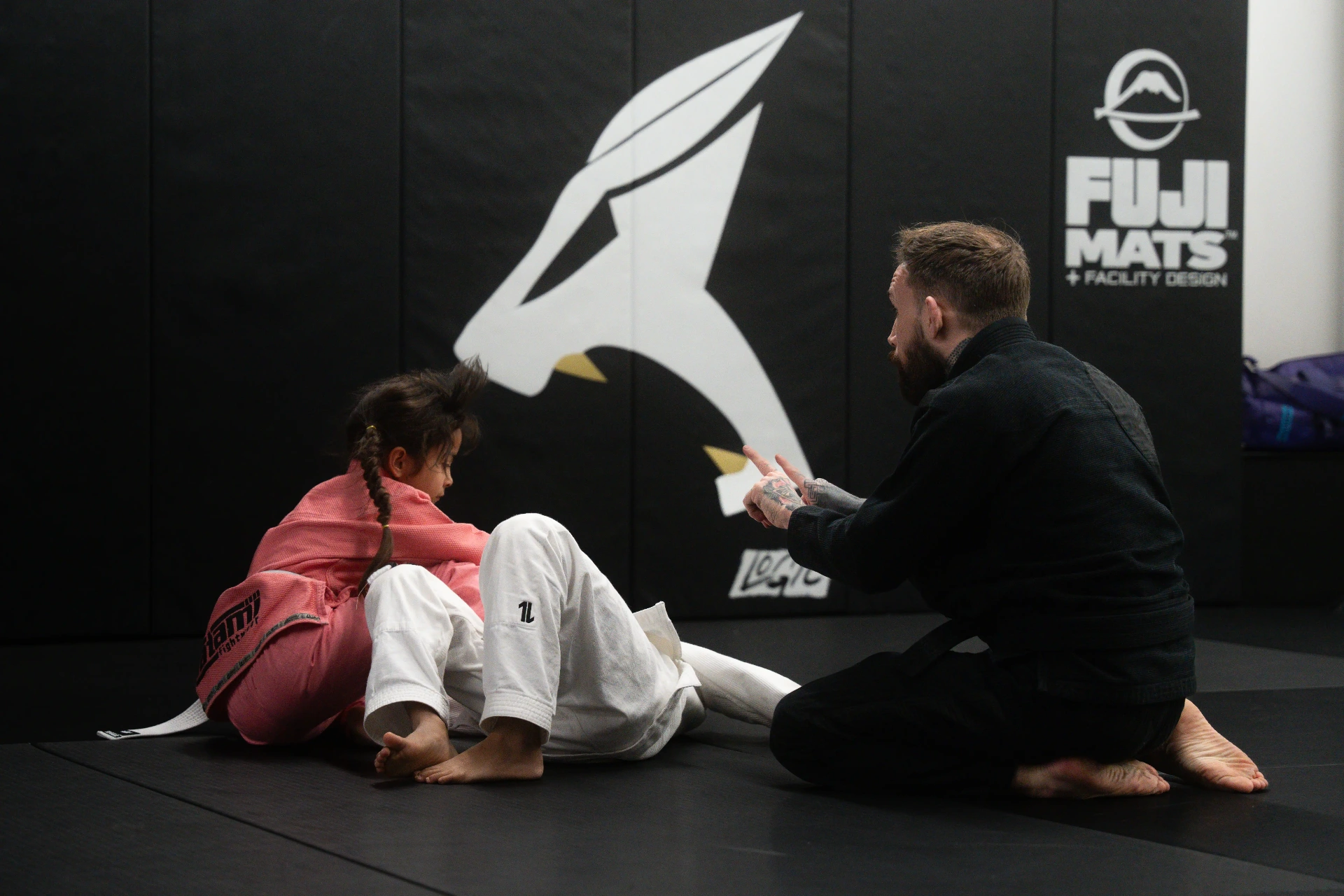
The pattern we see with quiet kids at Logic: weeks one and two they stand at the edge of the mat. Week three they have one friend. Week five they walk into the room ahead of their parent. Groups are capped at 8, which is a small enough room that a shy kid can't disappear into it — and small enough that they aren't overwhelmed.
The Bullying Question — An Honest Answer
Parents usually aren't asking "will my kid win a fight." They're asking "will my kid stop being a target." Those are different problems, and jiu jitsu is genuinely good at the second one.
Bullying is mostly a selection process. Kids who look like they'll freeze, apologize, or shrink get chosen. Kids who train grappling do three things differently without ever thinking about it: they hold posture, they hold eye contact, and they don't panic when someone invades their space — because that happens to them every class in a controlled setting.
There's a second layer that matters more. Jiu jitsu is the one martial art built to control a person without hurting them. A kid who's cornered doesn't have to choose between doing nothing and throwing a punch. Holding someone still until an adult arrives is a real, teachable third option — and it's the one that keeps your child out of trouble too.
What to tell your child
"You never start it. You never show it off. If someone puts hands on you, you control them and you get to an adult." Say it exactly like that, and repeat it. Kids follow rules they can remember under stress.
The Confidence Timeline
| When | On the mat | What you notice at home |
|---|---|---|
| Week 1 | Nervous, watching more than doing | Tired kid, better bedtime |
| Week 2–3 | Knows the routine, has one friend | Asks when the next class is; better eye contact |
| Month 2 | Wins positions against classmates | Talks about class unprompted; handles losing games better |
| Month 4 | First stripe or belt earned | Tries hard things without needing a guarantee of success |
| Month 6+ | Helps newer kids; identity as "someone who trains" | Speaks up more; the shrinking posture is gone |
This is the pattern across our kids groups in Fishtown. Every child moves at their own pace — some faster, some slower.
Why Getting Tapped Is the Point
In jiu jitsu, losing a position is normal, frequent, and completely safe. Your child will be in a bad spot, escape some of the time, and fail the rest. Then class ends, everyone shakes hands, and nothing bad happened.
That's a rehearsal for failure with the stakes removed — and it's the reason parents report the biggest change in how their kid handles setbacks at school. A child who has been stuck and worked their way out a hundred times stops treating difficulty as proof they're not good enough.
What Jiu Jitsu Will Not Fix
We'd rather be straight with you than oversell it:
- —It's not treatment for a diagnosed anxiety disorder, trauma, or depression. It can support that work; it doesn't replace a clinician.
- —It won't work if your child comes twice and stops. The mechanism is repetition. Two classes a week for a few months is the minimum for real change.
- —A serious ongoing bullying situation still needs the school involved. Jiu jitsu changes how your kid carries themselves — it doesn't discipline another child.
How Our Kids Classes Are Built for This
- ✓Groups capped at 8, so every kid gets coached by name
- ✓Cohorts start together every Monday — your child isn't the new kid in an established group
- ✓Partners matched by size and age, assigned by coaches
- ✓Every instructor is SafeSport certified and background checked — and most are parents themselves
- ✓Parents are welcome to stay and watch every class
How It Compares to the Other Options You're Considering
Every activity helps a kid in some way. The question is which mechanism your specific child needs.
| Activity | Confidence comes from | Best for |
|---|---|---|
| Jiu jitsu | Solving physical problems against real resistance, alone but coached | Shy, anxious, or targeted kids; kids who quit team sports |
| Team sports | Belonging and shared wins | Already-outgoing kids who thrive on a crowd |
| Striking arts | Aggression outlet and forms performed for a grade | Kids who want performance; carries head-impact risk |
| Individual sports (swim, track) | Personal times improving on a clock | Self-motivated kids; less social pressure practice |
Class Times, Cost, and How to Start
| Day | Time | Format |
|---|---|---|
| Monday | 5:00 – 6:00pm | Gi |
| Tuesday | 5:00 – 6:00pm | No-Gi |
| Wednesday | 5:00 – 6:00pm | Gi |
| Thursday | 5:00 – 6:00pm | No-Gi |
14 days of coached kids classes for $69 — uniform included. Membership after that is $49/week. New groups start every Monday at 1360 N American St in Fishtown, with free parking on site. Full details on the kids program page and the pricing page.
Keep reading
Watch it happen to your kid.
Ages 4+. Groups capped at 8 and they start every Monday in Fishtown. Come see a class and decide from there.
See the Kids Program →Ready to get your kid started?
Logic Kids Jiu Jitsu — confidence, discipline, and real skill, taught by black belts who know how to coach kids.
Explore Kids Classes →